Thru-Hiking vs. Backpacking: The Difference and Why It Matters
Somewhere along the way, backpacking started to look like it only counted if you quit your job, hiked from Georgia to Maine, knew your base weight to the tenth of an ounce, and had a trail name.
That version of backpacking is inspiring, but it is not the only version.
Thru-hiking gets a lot of attention because it has a clear story: a beginning, a struggle, a transformation, and a finish. It also makes great social media content. Long trails, big views, ultralight gear, resupply stops, shelters, hostels, and massive daily mileage all package well online.
But for many of us, especially those getting into or back into backpacking after 40, that is not the reality. We have jobs, families, limited vacation time, old injuries, different recovery needs, and a much lower tolerance for suffering just to prove a point.
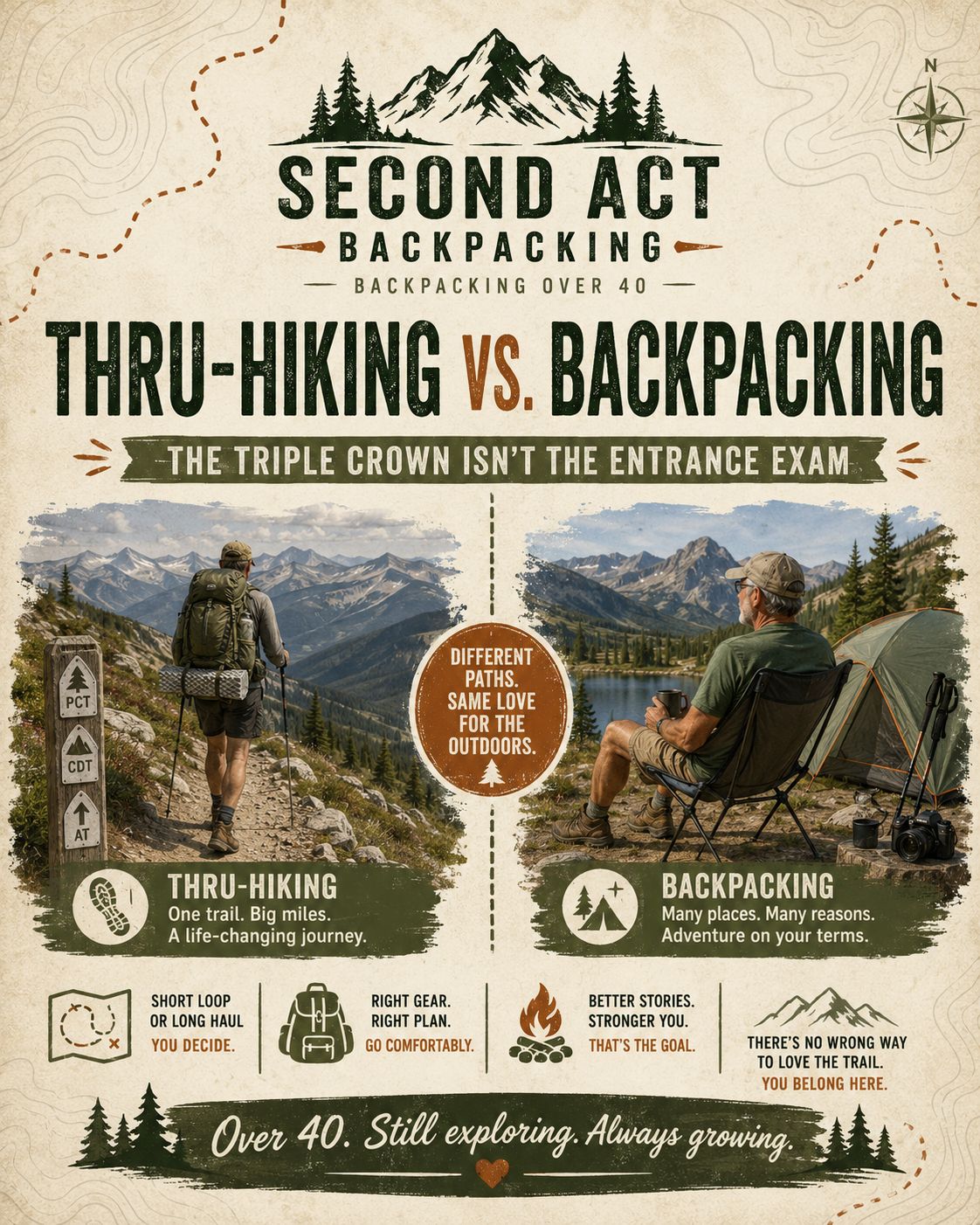
The good news is simple: Thru-hiking is a type of backpacking, but backpacking is not just thru-hiking.
PODCAST EPISODE COMPANION ARTICLE:
This article is a companion to Episode 8 of our Second Act Backpacking Podcast. Get the episode here:
What Is Thru-Hiking?
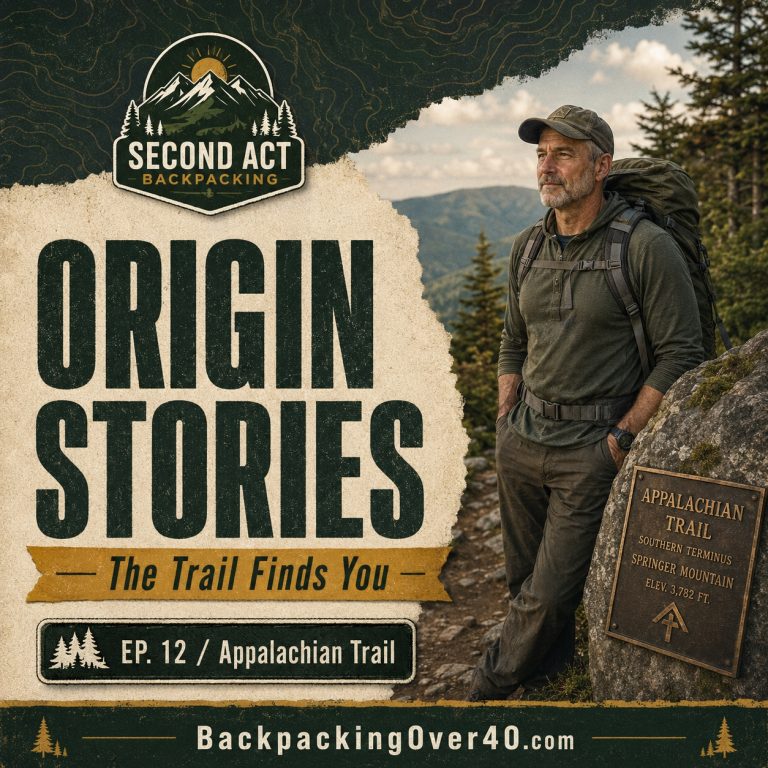
Thru-hiking usually means attempting an entire long-distance trail from end to end in one continuous push. That may mean hiking the Appalachian Trail, Pacific Crest Trail, Continental Divide Trail, or another long trail for weeks or months.
Thru-hiking often involves:
Long mileage days
Frequent resupply
A lighter gear setup
Extended time away from home
A strong trail culture
Physical and mental endurance
A start-to-finish objective
Thru-hiking is impressive. It takes discipline, planning, grit, resilience, and a serious commitment of time. The people who complete long trails deserve respect.
But that does not mean thru-hiking defines all backpacking.
What Is Backpacking?
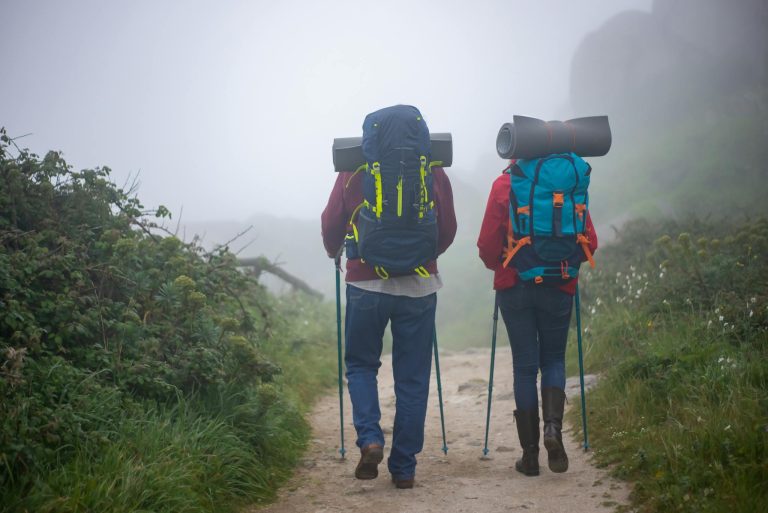
Backpacking is broader. At its simplest, backpacking means carrying your shelter, sleep system, food, water, clothing, and safety gear on your back and spending at least one night outside.
That can include:
A one-night shakedown trip
A weekend loop
A short out-and-back overnight
A section hike
A basecamp trip
A fishing-focused overnight
A photography-focused backpacking trip
A hunting backpack trip
A slow scenic route
A low-mileage trip with extra comfort gear
A state park loop
A local overnight near home
If you are carrying what you need, traveling on foot, sleeping outside, and planning your own trip, you are backpacking. The trail does not check your social media following, your base weight, your daily mileage, or whether you have a trail name.
Why Thru-Hiking Dominates Backpacking Media
Thru-hiking dominates the online conversation because it is easy to turn into a story.
A thru-hike has a natural arc:
The start
The struggle
The transformation
The finish
It also creates dramatic content. There are big views, gear changes, physical challenges, weather events, trail towns, resupply points, and emotional milestones. Social media rewards extremes, and thru-hiking offers plenty of them: longest days, lightest packs, hardest climbs, biggest risks, and most dramatic transformations.
Gear companies also benefit from thru-hiking culture because it gives them a clean narrative. This pack crossed the PCT. This quilt survived the CDT. This shelter made it from Georgia to Maine.
That is useful information, but it can also make newer backpackers feel like the thru-hiker standard is the only standard.
It is not.
What Gets Lost in the Noise
When thru-hiking becomes the dominant image of backpacking, a lot of normal backpackers start to feel like they are doing it wrong.
You may think:
My pack is too heavy.
My miles are too low.
My trip is too short.
I am not ultralight enough.
I am not young enough.
I cannot take enough time off.
I need better gear before I start.
I need to suffer more for it to count.
None of that is true.
Backpacking is not validated by how miserable you were, how low your base weight was, or how far you hiked in a day. It is validated by whether you planned well, moved safely, learned something, enjoyed the experience, and came home wanting to go again.
That is especially true for backpackers over 40.
Backpacking Over 40 Looks Different
Backpacking later in life often comes with a different reality.
You may be managing:
Limited vacation time
Family obligations
A demanding job
Old injuries
Knee, back, hip, or foot issues
More recovery needs
Sleep priorities
Hydration and nutrition needs
Less interest in unnecessary risk
A stronger desire for comfort
At 20 or 25, being wet, cold, hungry, underprepared, and exhausted might make a great story. After 40, the goal often changes.
The goal becomes being capable, comfortable enough, safe enough, and smart enough to enjoy the trip and still function when you get home.
That does not make you less of a backpacker. It means your priorities have matured.
Do Not Copy a Thru-Hiker’s Gear List Blindly
Thru-hiker gear lists can be helpful, but they are built around a specific problem: carrying gear for many miles, day after day, over a long trail.
That may not be your problem.
A thru-hiker trying to hike 25 miles a day for five months has different needs than someone hiking six miles to camp for a weekend. A person trying to complete the Pacific Crest Trail has different constraints than someone doing a two-night loop in North Carolina. A hiker chasing an ultralight base weight has different tradeoffs than someone who wants better sleep, more recovery, or a camp chair for photography.
The better approach is this:
Do not copy someone else’s gear list. Understand the problem their gear list is solving.
Then ask whether you actually have that same problem.
Better Questions to Ask Before Your Trip
Instead of asking, “What do thru-hikers use?” ask:
What kind of trip am I actually taking?
How many nights will I be out?
How many miles will I hike each day?
What season is it?
What is the terrain like?
What weather is likely?
What risks do I need to manage?
What skills do I need before I go?
What gear helps me stay safe?
What comfort items help me recover?
What will make me want to do this again?
Those questions are far more useful than trying to match an influencer’s lighterpack list or shaving ounces from gear that actually helps you enjoy the trip.
Comfort Is Not Failure
There is nothing wrong with wanting to be comfortable.
That does not mean carrying the entire house on your back. It means making intentional choices that support your actual goals.
Maybe that means a wider sleeping pad because sleep matters more now.
Maybe it means a warmer quilt because being cold ruins your recovery.
Maybe it means real food instead of eating the same cheap noodles every night.
Maybe it means camp shoes.
Maybe it means a chair.
Maybe it means carrying a camera because photography is part of why you are out there.
Comfort gear is not automatically bad. Unexamined gear is the problem. If the item serves a purpose and fits your trip, it may be worth the weight.
Thru-Hikers Deserve Respect, But They Are Not the Standard for Everyone
This is not about criticizing thru-hikers. Thru-hiking is incredible. Anyone who completes a long trail has done something that requires discipline, planning, toughness, and commitment.
The issue is not thru-hiking itself.
The issue is when one version of backpacking becomes the measuring stick for everyone else.
The Triple Crown is an achievement. It is not an entrance exam.
You do not need to hike the Appalachian Trail, Pacific Crest Trail, or Continental Divide Trail to call yourself a backpacker. You do not need to carry an ultralight pack. You do not need to hike 25-mile days. You do not need to make every trip a test of suffering.
You need to plan well, carry what you need, get outside, learn, and come back wanting to go again.
Backpacking Belongs to the Rest of Us Too
Backpacking belongs to the weekend hiker.
It belongs to the section hiker.
It belongs to the older beginner.
It belongs to the person coming back after years away.
It belongs to the person with bad knees and a full-time job.
It belongs to the person doing a one-night shakedown trip.
It belongs to the person hiking to a trout stream.
It belongs to the person carrying camera gear to photograph birds at sunrise.
It belongs to the person walking a state park loop and sleeping under the stars.
Backpacking is not about meeting someone else’s definition. It is about building the skills, confidence, judgment, and gear system that let you safely enjoy your own trail.
Thru-Hiking vs. Backpacking: Final Thought
The difference between thru-hiking and backpacking matters, but not because one is better than the other.
It matters because a lot of people delay getting started because they think backpacking has to look like the extreme version they see online.
It does not.
Pick a realistic trip. Build a reasonable kit. Learn the basics. Be honest about your body, schedule, goals, and risk tolerance. Then get outside.
You do not have to hike 2,000 miles to belong.