Backpacking Later in Life: Origin stories
Every backpacker has an origin story.
Some people find backpacking through Scouts, family camping trips, summer camps, or a friend who talked them into carrying a pack farther than they probably should have. Some people come to it later, after years of day hiking, car camping, or watching other people disappear into the mountains and wondering what it would feel like to do the same.
And for many people getting into backpacking later in life, that origin story comes with a little regret.
Maybe you wish you had started sooner. Maybe you had a big trail dream when you were younger and never followed through. Maybe work, marriage, kids, bills, injuries, school, or just the normal pressure of being a responsible adult pushed backpacking into the background for a while.
That does not mean the story is over.
For many of us, backpacking over 40 is not really about starting from scratch. It is about returning to something that was always somewhere in the back of our minds. It is about finally making room for the trail again.
Listen to the Episode
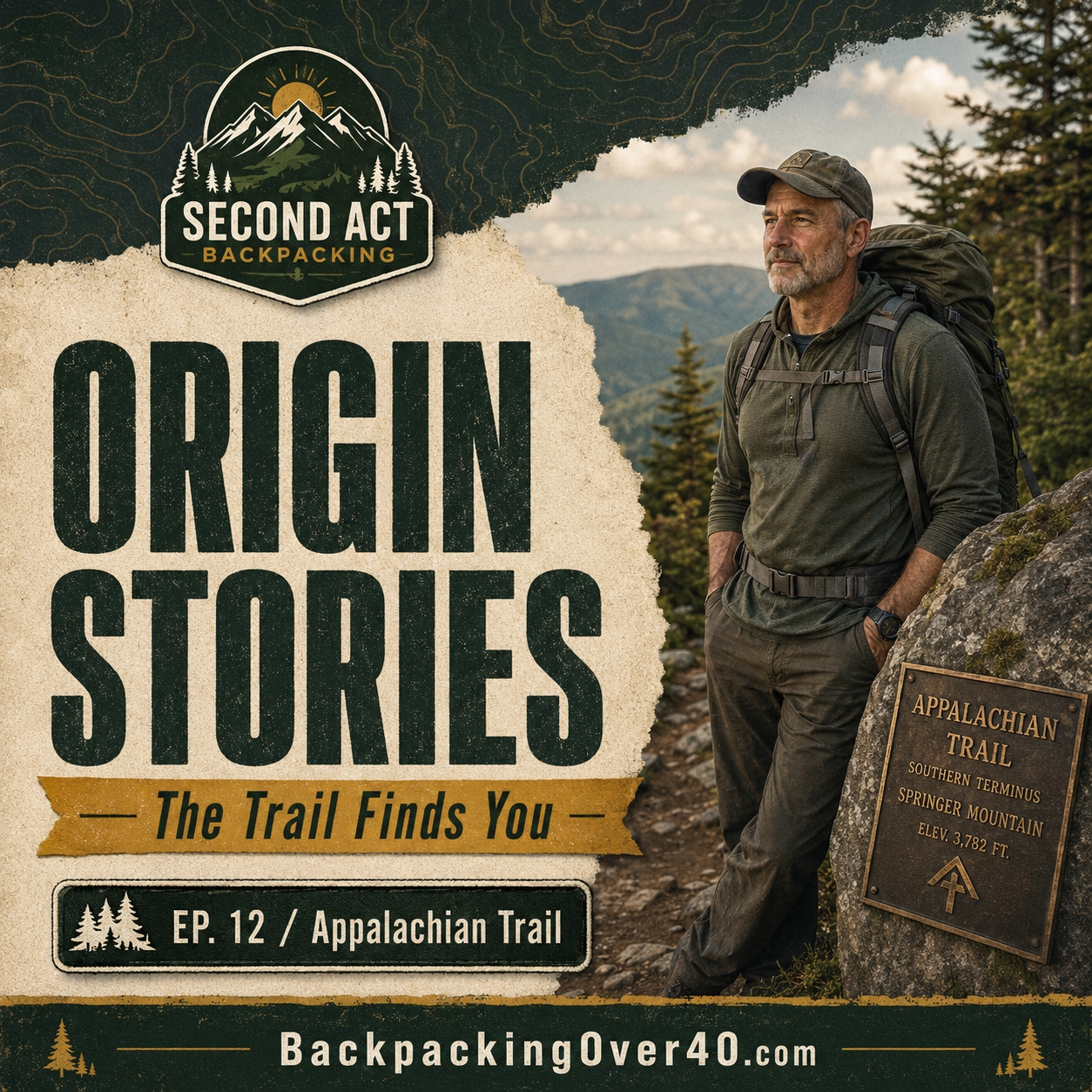
This article is based on Episode 12 of the Second Act Backpacking Podcast, where we talk about backpacker origin stories, regret, timing, and what it means to finally step onto a trail you have thought about for decades.
Podcast: Second Act Backpacking
YouTube and Instagram: @SecondActBackpacking
Every Backpacker Has an Origin Story
Backpacking often starts with one moment.
It might be the first time you saw a mountain view after earning every step of the climb. It might be the first night you slept outside and realized the woods sound completely different after dark. It might be a book, a map, a documentary, a friend, or a trail sign that made something click in your head.
For me, that moment came when I was young and first learned about the Appalachian Trail.
I had been introduced to camping and the outdoors through Cub Scouts and Boy Scouts. That gave me some early exposure to hiking, camping, and carrying gear outside. But there is a big difference between being part of an adult-led outdoor activity and having your own personal pull toward the backcountry.
That pull came when I heard a presentation about long-distance backpacking and thru-hiking the Appalachian Trail.
The idea of a trail stretching for more than 2,000 miles through the mountains absolutely captured my imagination. It felt almost impossible, but also somehow available. It was just out there. A person could step onto it and start walking.
That idea stayed with me.
I checked out books from the library. I read about the Appalachian Trail. I looked at maps. I imagined what it would be like to hike it. For a kid, that kind of dream can feel massive. It is adventure, independence, challenge, and freedom all rolled into one.
That was my backpacking origin story.
Not a completed thru-hike. Not a perfect first trip. Not some polished outdoor résumé.
Just a kid learning that there was a long trail in the mountains and deciding, “I want to do that someday.”
When the Appalachian Trail Becomes the Dream
The Appalachian Trail has a way of becoming more than just a trail.
For some people, it is a bucket list item. For others, it is a personal challenge. For others, it represents escape, healing, freedom, or proof that they can still do hard things.
When I first became interested in backpacking, the Appalachian Trail became the thing I wanted to do. I was not just interested in going camping. I was not just interested in short hikes. I wanted to backpack the AT.
Like many people who get hooked on a big-trail dream, I started planning before I had the life experience to understand what that kind of goal really required. I looked at the mileage. I thought about supply points. I tried to understand the logistics. I imagined the timeline.
And for a while, it looked like maybe it could happen after high school.
But life rarely follows the clean route we draw on paper.
That is one of the first lessons backpacking teaches you, even before you get on the trail. The plan matters, but the plan is not reality. Weather changes. Gear fails. People change. Priorities shift. Money gets tight. Jobs get in the way. Family responsibilities show up.
The trail may be simple.
Life usually is not.
Life Does Not Always Make Room for the Trail
One of the hardest parts about backpacking later in life is accepting that there may have been a long stretch of years when you simply could not make it happen. That can be frustrating, especially when you look around and see people taking big trips, hiking long sections, or completing thru-hikes while you are trying to keep up with work, parenting, school, bills, and everything else that comes with adulthood.
Marriage happens. Kids happen. Work happens. Bills happen. Responsibilities multiply.
For me, backpacking did not disappear completely, but it moved into the background. Day hiking was still possible. Short trips were sometimes possible. But the idea of disappearing for weeks or months to chase a long trail was not realistic for that season of life.
That is not a complaint.
For many of us, family is not an obstacle in a negative sense. Family is the best and most meaningful part of life. But it does change the logistics. A person with young kids at home may not be able to vanish for an extended backpacking trip without creating real strain on the people they love.
That is part of the honest conversation about backpacking over 40.
It is not just about whether your knees can handle the miles. It is not just about whether your pack is too heavy or whether you bought the right shelter. It is also about life structure.
Do you have the time?
Do you have the support?
Do you have the flexibility?
Do you have the energy?
Can you do this without creating unnecessary stress at home?
Those questions matter.
And sometimes the answer is, “Not right now.”
That does not mean “never.”
The Regret of Waiting
When you have carried a trail dream for decades, regret can sneak up on you.
You start thinking about the years that passed. You think about the trips you did not take. You think about the chances you missed. You wonder why you did not push harder, plan better, save more, or make the trail a bigger priority.
That regret can be especially strong for people getting into backpacking later in life.
You may feel like you are behind. You may feel like everyone else already had their big adventure. You may feel like the window is closing. You may even feel a little angry with yourself.
But regret is not always telling the whole truth.
Sometimes we look back and judge our younger selves without remembering the full reality of that season. We forget the financial pressure. We forget the lack of support. We forget the uncertainty. We forget how much we were carrying at the time.
There is also a deeper question worth asking:
Did you want the experience, or did you want the accomplishment?
That question matters.
There is nothing wrong with wanting to complete a major trail. There is nothing wrong with chasing a big goal. But if the only value is in saying you finished, then it is easy to miss what the trail is actually offering.
There is a quote I have always liked:
Climb the mountain so you can see the world, not so the world can see you.
That applies to backpacking.
The trail is not just a scoreboard. It is not just a place to collect miles, check boxes, or prove something to strangers. The trail is a place to experience the world more directly. It is a place to slow down, pay attention, learn, struggle, recover, and grow.
If you are backpacking later in life, that mindset shift can change everything.
Redefining Success on the Trail
At some point, I had to stop making the Appalachian Trail an all-or-nothing goal.
For years, the big dream was the whole trail. A thru-hike. The complete thing. Start to finish. One continuous line.
But as I got older, I started to realize that the pressure to complete the entire thing was getting in the way of simply experiencing it.
So I changed the goal.
Instead of saying, “I need to hike the whole Appalachian Trail,” I set a smaller goal.
I wanted to reach the southern terminus at Springer Mountain.
That was it.
Not a thru-hike. Not a giant section. Not a perfectly planned expedition. Just get there. Step onto the trail. See the place that had lived in my imagination since I was young.
That smaller goal changed the emotional weight of the whole thing.
This is important for backpackers over 40, especially those who are trying to restart after years away. Your goal does not have to impress anyone. It does not have to match what thru-hikers are doing. It does not have to look good on social media.
A good backpacking goal is one that fits your actual life and gets you outside.
That might be your first overnight trip.
It might be a two-mile hike with a loaded pack.
It might be a weekend section of a longer trail.
It might be learning how to use your stove, filter water, or set up your shelter in the rain.
It might be stepping onto a trail you have thought about for 30 years.
That counts.
The miles still count, even if they happen later than you planned.
Finally Stepping Onto the Appalachian Trail
Sometimes the trail shows up when you stop trying to force the perfect version of the plan.
After years of thinking about the Appalachian Trail, I finally had an unexpected opportunity to step onto it. Work took me into western North Carolina, and on the drive back I passed near the Nantahala Outdoor Center, where the Appalachian Trail crosses through.
I saw the marker on the map. I pulled over. I found where the trail came out of the woods.
And I walked maybe 100 feet up the Appalachian Trail.
That was it.
No grand entrance. No backpacking trip. No huge mileage. No dramatic summit photo. My car was not even parked in a place where I could stay long.
But after decades of thinking about that trail, I had finally stepped onto it.
It felt bigger than the actual moment should have felt. From the outside, it was nothing. A short walk. A tiny distance. Barely enough to register as a hike.
But internally, it mattered.
That is something people sometimes miss about backpacking later in life. The emotional weight of a trip is not always tied to mileage. Sometimes a short walk means more than a long hike because of what it represents.
For me, that short moment near the Nantahala Outdoor Center cracked something open.
It made the trail real again.
Getting to Springer Mountain
Not long after that first brief step onto the Appalachian Trail, another opportunity came up. Work brought me back to the same general area, and my wife was able to come along. While looking at the map, I realized Springer Mountain was within reach.
The southern terminus of the Appalachian Trail was close enough to visit.
So we went.
It was not a perfectly planned backpacking trip. It was not the version I had imagined as a teenager. It was a short hike from a Forest Service road, pieced together with the gear and time we had available.
And it was exactly what it needed to be.
We took our time. We stopped to look at mushrooms, slugs, plants, and all the little things you miss when your only goal is to get to the destination as fast as possible. Part of my brain wanted to push to the top. Another part knew better.
The point was not just to get there.
The point was to experience it.
When we reached Springer Mountain, I got to see the plaques, take pictures, stand there with my wife, and finally connect a real place to a dream I had carried since childhood.
That mattered.
Not because it completed the Appalachian Trail for me. It did not. Not because it checked off some massive public accomplishment. It did not.
It mattered because it reminded me that the trail does not have to happen exactly the way younger me imagined it.
Sometimes the later version is better.
Older Does Not Mean Too Late
There is a strange pressure in outdoor culture to do everything young, fast, light, and impressive.
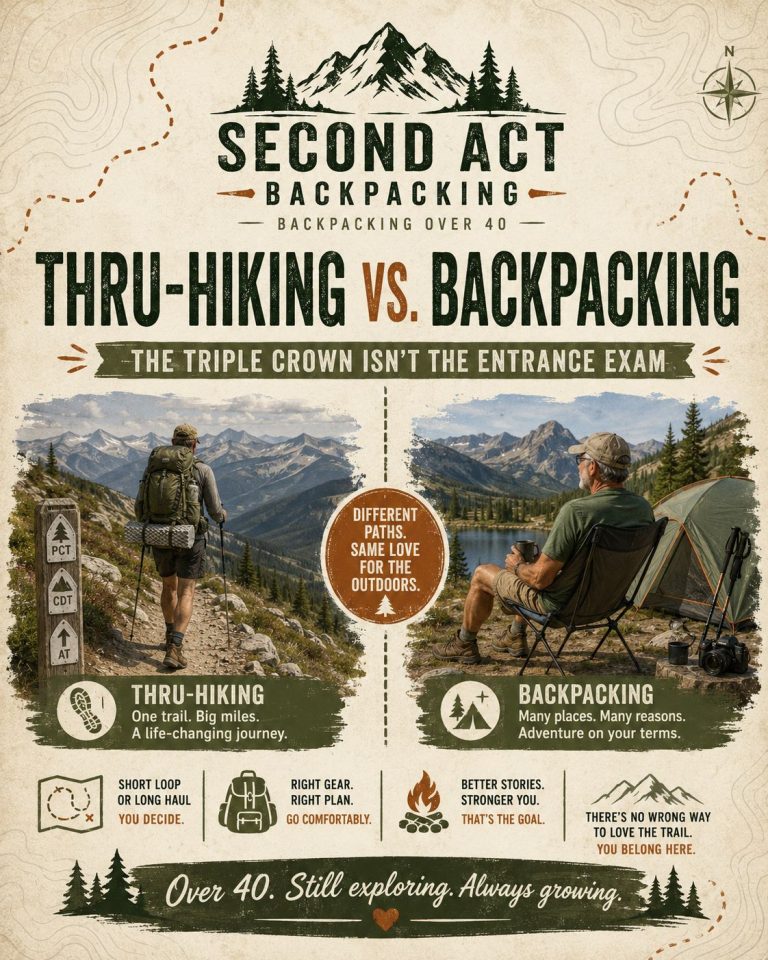
Thru-hiking content can make it feel like the “real” backpackers are the ones crushing miles, living out of a pack for months, or chasing the Triple Crown. There is nothing wrong with those goals. They are impressive. They matter.
But they are not the only valid way to be a backpacker.
Backpacking later in life often looks different.
You may have less free time, but more patience.
You may move slower, but notice more.
You may carry old injuries, but also better judgment.
You may not care about proving yourself the way you once did.
You may be more willing to stop, look around, and actually enjoy where you are.
That is not a weakness.
That may be the whole point.
When I was younger, I probably would have treated the Appalachian Trail like a task. I would have focused on mileage, pace, and progress. I would have pushed hard and kept my head down.
Now, I am much more interested in the experience.
That is one of the gifts of getting older. You start to understand that the destination is not the whole story. You start to care less about whether the trip looks impressive and more about whether it feels meaningful.
For backpackers over 40, that is a powerful shift.
Your Trail Story Is Still Being Written
If you are getting into backpacking later in life, returning after years away, or carrying an old trail dream that still has not happened, remember this:
You are not too late.
Your origin story may have gaps in it. It may have regret. It may have years where nothing happened. It may include bad gear, heavy packs, missed chances, family responsibilities, work conflicts, and plans that fell apart.
That does not make the story a failure.
It makes it real.
The trail does not care whether you started at 18, 38, 48, or 68. The trail does not care whether you are thru-hiking, section hiking, weekend backpacking, or just trying to build enough confidence for your first overnight.
What matters is that you are learning, growing, and getting out there in a way that fits your life now.
Not the life you wish you had.
Not the life someone else has.
Not the life social media tells you a backpacker is supposed to have.
Your actual life.
That is where the trail has to fit.
A Better Way to Think About Backpacking Goals
Big goals are good. Dreaming about long trails is good. Wanting to hike the Appalachian Trail, the Pacific Crest Trail, the Mountains-to-Sea Trail, or any other major route can be motivating and meaningful.
But your goals should serve your life, not punish you for having one.
A better way to think about backpacking later in life is to ask:
What version of this goal gets me outside soon?
What version fits my family, work, health, and responsibilities?
What would help me build confidence instead of frustration?
What would let me enjoy the trail instead of turning it into pressure?
Maybe the answer is not a thru-hike right now.
Maybe it is a section.
Maybe it is a weekend.
Maybe it is one night.
Maybe it is one trailhead.
Maybe it is finally standing at the place you have thought about for decades.
That is enough to begin.
And beginning matters.
Final Thoughts
Everyone on the trail has an origin story.
The person passing you with a tiny pack has one. The older backpacker moving slowly up the climb has one. The couple stopping to look at mushrooms has one. The beginner struggling with too much gear has one. The day hiker wondering whether they could ever try an overnight has one too.
The older we get, the more likely those stories include some regret. Things we wish we had done earlier. Trips we wish we had taken. Chances we wish we had not missed.
But regret does not get the final word.
The trail is still there.
You can still start. You can still return. You can still learn. You can still build confidence. You can still create a backpacking life that fits who you are now.
It is okay to be slow.
It is okay to be deliberate.
It is okay to take your time.
It is okay if your backpacking story does not look like anyone else’s.
Your trail story is not too late.
It is still being written.
Listen to Episode 12 of the Second Act Backpacking Podcast for the full story.
Visit BackpackingOver40.com for podcast episodes, companion articles, gear reviews, and practical backpacking content for people getting into or back into backpacking later in life.
Follow along on YouTube and Instagram: @SecondActBackpacking